No one can say who cleans which room
Responsibilities sit between practice staff, a contractor and sometimes the landlord, and nothing is written down.
Clinical cleaning for GP practices
Cleaning planned around your rooms, clinical activities and opening hours, with an agreed specification, clear responsibilities and documented checks.
Serving Maidstone and the South East, including London.
Self-check
Seven gaps practice managers often find when they look closely. Tick any that sound familiar and we will carry them into your enquiry as points to discuss.
Responsibilities sit between practice staff, a contractor and sometimes the landlord, and nothing is written down.
Rooms used for examinations and minor procedures need a different specification from offices and corridors.
If a visit or inspection asks for evidence of what was done and when, the answer is a verbal one.
The specification holds when the usual cleaner is in, and slips when they are not.
Rooms change use, services expand, and the cleaning schedule still reflects the building as it was.
Soap, towels and liners are ordered by whoever notices, and gaps appear at the worst moment.
There is no routine check against what was agreed, so drift goes unnoticed until someone raises it.
Responsibilities
Before work starts, agree in writing who is responsible for general surfaces, clinical equipment and between-patient tasks. We do not take on clinical responsibilities unless they are set out in an agreed specification.
| Area or task | Practice team | Current contractor | Aridom Sanex |
|---|---|---|---|
| Consulting and treatment rooms | Agreed with you | Agreed with you | Agreed with you |
| Waiting areas, toilets and corridors | Agreed with you | Agreed with you | Agreed with you |
| Clinical equipment and between-patient tasks | Agreed with you | Agreed with you | Agreed with you |
| Consumables and dispensers | Agreed with you | Agreed with you | Agreed with you |
| Checks and records | Agreed with you | Agreed with you | Agreed with you |
Example layout. Your version is built from your own rooms and arrangements.
How to judge a provider
Disinfectant results are often quoted as a "log reduction". It is a simple measure of how much a laboratory count fell. It is worth understanding before you compare providers.
A test surface starts with 1,000,000 organisms. After treatment, 10 remain. 1,000,000 ÷ 10 = 100,000, which is 105. That is a 5-log reduction.
1-log removes 90%. 2-log removes 99%. 3-log removes 99.9%. The percentages look close, but the number of organisms left differs by ten times at every step.
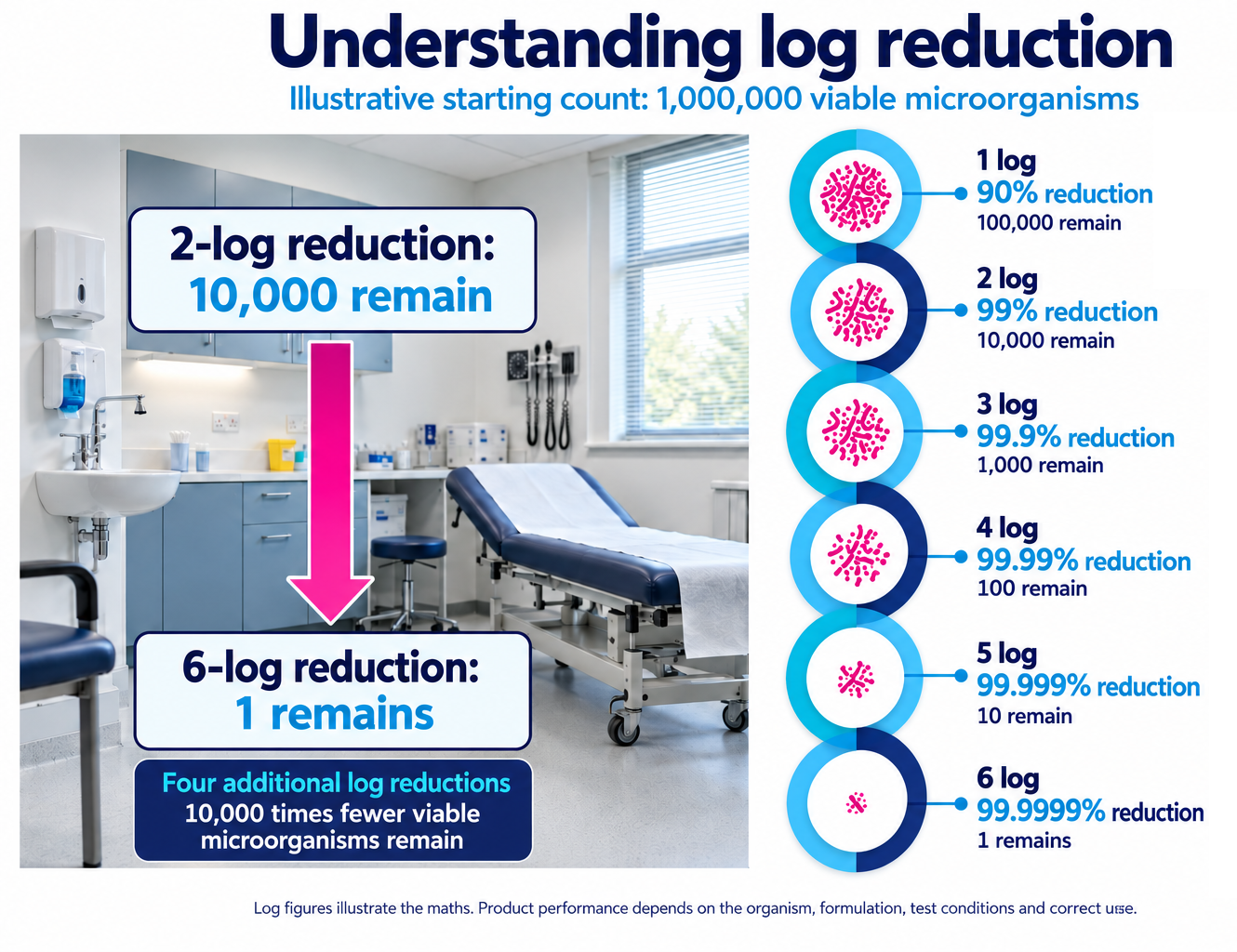
Log figures illustrate the arithmetic only. Product performance depends on the organism, formulation, test conditions and correct use.
Two figures are only comparable when the test standard, organism, contact time and conditions match. Ask for all four.
It shows what a product did under test conditions. It does not show that a room is clean, or that infection is prevented.
The right product used badly, or too briefly, will not perform as tested. Specification, training and checks carry as much weight as the number.
How we choose products
A fresh or fragrant smell and a polished surface create a good impression, and products are often chosen because they smell pleasant. Neither shows how effectively microorganisms have been removed or inactivated.
At Aridom Sanex, product selection forms part of the cleaning specification. We consider the task, the surface and the relevant efficacy evidence.
Correct application and the required contact time matter alongside the product. The product and the operative's method work together.
The log reduction diagram explains what microbial reduction means. It does not show how any product performs. That needs the product's supporting test report.
How the service is managed
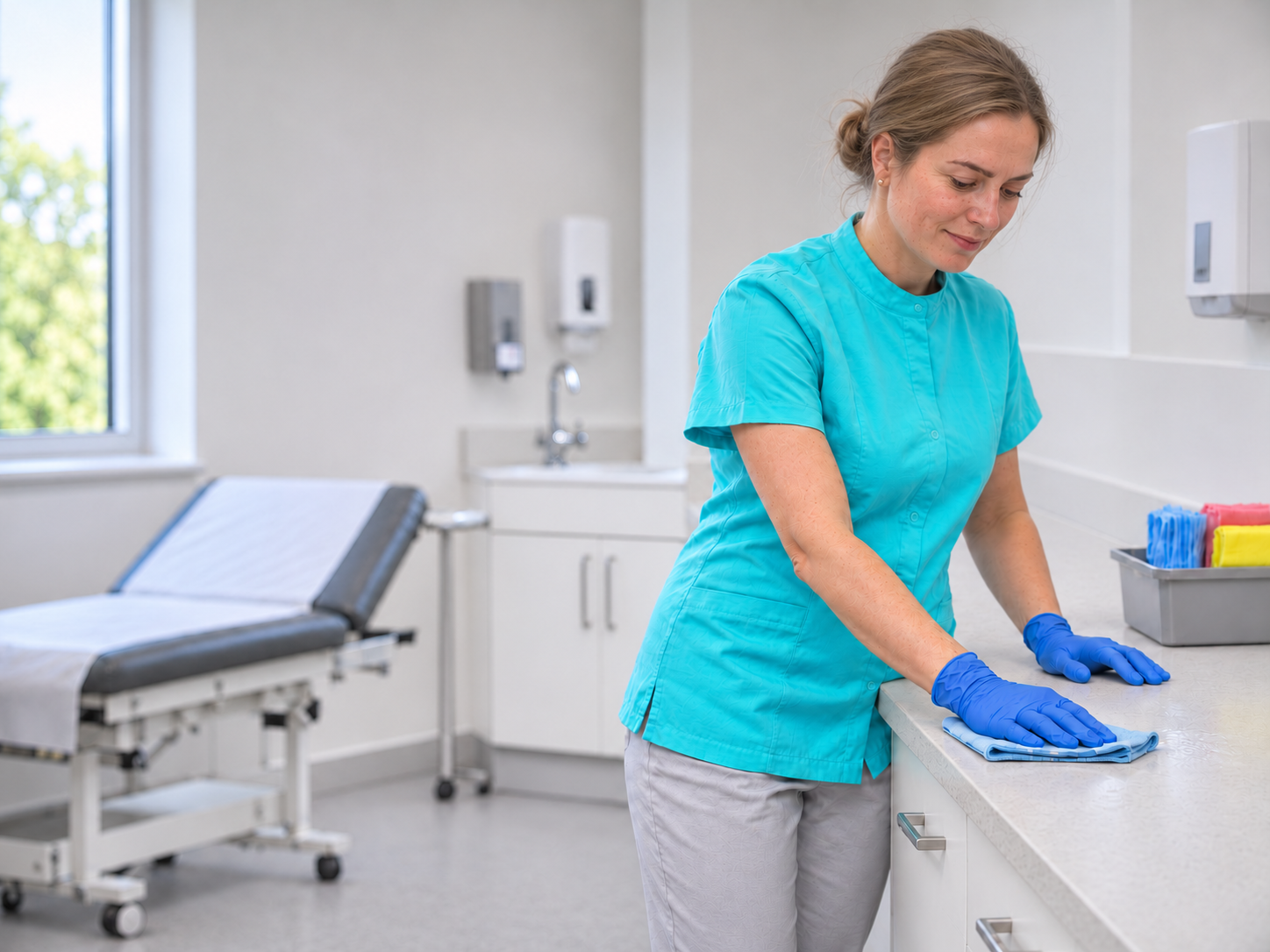
The starting point is a clear specification: which tasks are needed, in which rooms, how often and who is responsible. Staffing and time must then match that scope.
We look at your rooms, activities and high-touch points, then agree what is cleaned, how often, by whom and to what standard.
Trained, supervised teams work to written schedules. Agreed checks confirm the work has been done as specified.
When something falls short, it is recorded, corrected and followed up. The specification is reviewed as your practice changes.
We offer a complimentary 30-minute visit. You request it through the form below, and we then agree a time with you.
Take a closer look
Three ways to see how we work before you speak to us: a short overview, a short film and our guide for practice managers.
A short document setting out how we specify, deliver and check clinical cleaning in practice premises.
View the overviewA short film on how we plan, carry out and check cleaning in a clinical setting. Illustrative film.
Watch our approachWhat to look for in the specification, responsibilities, cleaning records and quality checks when you review your cleaning arrangements.
Read the guideSupplies, to discuss
If required, we can supply a defined range of washroom and cleaning consumables alongside your cleaning service. Tell us which items you would like quoted and we will confirm quantities, delivery arrangements and a separate quotation.
From our range: toilet paper, paper hand towels, liquid hand soap, hand sanitiser, general waste bin liners, cleaning cloths and wipes, mop heads, cleaning and disinfection products, and wipe dispensers or refills.
Hygiene wipe system. If you want one, we install the dispenser, refill it as you need and supply the wipes and disinfectant.
Items are supplied from our own range and quoted separately. They are not included in the cleaning price unless expressly listed in your quotation. Product suitability and availability will be confirmed.
Why choose Aridom Sanex
We are a Maidstone company with a background in microbiology and infection prevention thinking, applied to the everyday question of how a practice is cleaned.
We separate what a product has been tested for from what is assumed, and we tell you which is which.
Your specification follows how each room is used, not a standard template.
Agreed standards, schedules and checks are written down, so responsibilities are clear.
Many surgeries gain more from clear schedules, responsibilities and records than from enhanced treatment. We say so when that is the case.
Recognised for sustainability

These are business awards. They are not an accreditation or certification of our cleaning service, and they do not imply NHS endorsement.
About the products
Straight answers on what we use in a practice, why, and where the limits are.
Our range includes InfectionGard multi-surface sanitising solution (330 ml, 1 L, 5 L and 20 L), DermaGard alcohol-free hand sanitiser (100 ml to 5 L), TriBioSan Zero, an odourless, taint-free HOCl biocide (1 L and 5 L), HygenaGel clinical spill absorbent granules, and BioSol cleaning solution for fogging equipment. We also work with PaquaLyte Anolyte, Neutra-S floor cleaner and TriBioSan Floor Wash for planned supply.
Which of these suits your practice depends on the surface, the task and your own infection control policy, so we agree the products with you before work starts. Availability and pricing are confirmed at the time.
We choose products to suit the surface, the room and the task, and agree them with you before work starts. A pH neutral, non-corrosive detergent such as Neutra-S is typically the first step. It lifts dirt, blood and other organic matter so the surface is ready for any disinfection that is needed. Safety data sheets can be provided for the products used at your site.
A disinfectant cannot work properly on a surface that is still soiled. Organic matter such as blood or body fluids can shield microbes from it, so physical cleaning comes first. That is why we do not treat disinfection or fogging as a substitute for cleaning.
We choose the product to suit the surface and the task, and we explain what we are using and why. Where disinfection is needed we may use a hypochlorous acid (HOCl) based product such as Paqualyte. Ask us about contact time, compatible surfaces and COSHH information for anything we propose.
Hypochlorous acid (HOCl) is a disinfectant active that breaks down to salt and water after use. It is not the same thing as household bleach. Evidence for HOCl in general does not automatically apply to every product or setting, so we only describe what has been tested for the specific product and process.
Our Cube S automated dry fogger disperses HOCl as a fine dry fog with sub-5 micron droplets, so it can reach surfaces that are hard to wipe, such as undersides and crevices, without wetting them. With Paqualyte 500 it has been independently tested and is compliant with BS EN 17272:2020, the standard for automated room disinfection. This standard tests the automated disinfection process. It does not set out the log reduction figures themselves, which come from separate European (EN) efficacy tests. Fogging works alongside cleaning, not instead of it.
It depends on your rooms and how they are used. In clinical spaces many practices choose to include it, so we offer it as an option within the cleaning programme. It works alongside cleaning, not instead of it, and we assess the room first. How often is agreed with you: at the end of each day if you want that, after a specific event such as an infectious case or an outbreak, or on another schedule that suits your practice. Re-entry is quick, so the room is back in use after a short time. We confirm the re-entry time for your room before work starts.
The HyGe 2-in-1 smart dispenser gives touch-free dry or pre-moistened wipes, with the amount of disinfectant controlled for each wipe. It is not limited to clinical rooms: where it is used, and with which disinfectant, depends on the room and your own protocol. It works with several disinfectants, with HOCl as the recommended option. See the product page for details, and discuss your requirements with us.
Yes. We can supply disposable mop heads and chemical safety and compliance posters, and we can talk you through the wipe dispenser. If something you rely on is missing from our range, tell us.
Enquiry
A short contact form. Five details and you are done. If you would like to help us prepare, there are six optional questions underneath.